

Managed IT
Email Security Reviews That Protect Operations
Email security reviews expose the gaps behind phishing, fraud, and outages, giving leaders a clear plan to protect access, continuity, and trust daily.
Web Design
Plan a Dubai website redesign that improves trust, performance, lead flow, and visibility with one accountable system from discovery to ongoing growth.
October 2026
A Dubai website redesign is rarely just a design decision. For an established business, it is often the point where outdated messaging, slow technology, fragmented lead handling, and unclear reporting become impossible to ignore. The right project does more than replace an old interface. It creates a better operating system for how customers find you, evaluate you, contact you, and move toward a commercial decision.
That distinction matters in a market where buyers compare providers quickly and expect clear information, fast mobile performance, credible proof, and dependable follow-up. A visually improved website that still sends unqualified inquiries into an unmanaged inbox has not solved the real business problem.
A redesign is justified when the current site is holding back a business outcome. That may be weak lead quality, an inability to update content without developer support, poor mobile conversion, low search visibility, or a site that no longer reflects the scale of the organization.
For some companies, the trigger is a brand change, a new service line, or an expansion into e-commerce. For others, it is operational risk. Legacy plugins, unsupported hosting environments, inconsistent forms, and weak access controls can turn a marketing asset into a continuity concern.
The answer is not always a full rebuild. If the existing platform has sound architecture and the issue is mainly positioning or content, a targeted redesign may be faster and more cost-effective. If the site is slow, difficult to maintain, poorly structured for search, and disconnected from business systems, rebuilding on a clean foundation is usually the more responsible decision.
Executives often begin a website conversation with comments about dated pages or competitor designs. Those observations are valid, but they should not define the project. The first question is simpler: where is the current website creating friction for customers or teams?
A healthcare provider may need clearer service pathways and stronger appointment inquiries. A real estate business may need better project discovery and lead routing. A B2B services firm may need its website to establish authority before a sales call. An e-commerce operator may need faster category pages, fewer checkout drop-offs, and more useful customer data.
These are different problems, so they require different priorities. A successful redesign starts by identifying the commercial actions that matter most: request a quote, book a consultation, submit an application, call a location, purchase a product, or access a client portal. Design decisions should support those actions rather than compete with them.
Before wireframes are approved, agree on what will be measured after launch. This may include qualified form submissions, booked meetings, calls from mobile users, revenue by channel, online transactions, document downloads, or time saved by internal teams.
Measurement needs ownership. Marketing may own campaign performance, sales may own lead follow-up, and IT may own access, uptime, integrations, and security. A redesign creates useful visibility only when these responsibilities are connected. Otherwise, teams can see traffic increase while still being unable to explain whether growth is producing real demand.
At ProiTs, website work is most effective when it follows a connected path: Discover, Design, Build, and Evolve. This approach prevents a common failure mode where a site is launched as a finished artifact, then left without optimization, maintenance, or accountability.
Discovery examines more than the current pages. It reviews audience segments, customer journeys, analytics, search performance, hosting, integrations, content governance, brand assets, and lead workflows. It should also include conversations with the people who answer calls, qualify inquiries, update products, and support customers after the sale.
This stage exposes gaps that analytics alone cannot show. A high-performing landing page may be producing inquiries that are never contacted promptly. A contact form may work on desktop but fail intermittently on mobile. A sales team may repeatedly answer questions that should be addressed clearly on key service pages.
The output should be a prioritized plan, not a vague collection of recommendations. It should clarify which pages need to exist, which content needs to be improved, which integrations are required, and what must be protected during migration.
Good website design reduces uncertainty. It tells a visitor what the business does, who it serves, why it is credible, and what to do next without forcing them to search for basic answers.
That requires information architecture before visual styling. Navigation, page hierarchy, service grouping, calls to action, and proof points should reflect the way customers make decisions. A procurement manager needs different reassurance from a consumer comparing prices. An operations leader may look for reliability, service coverage, and response expectations. A technical buyer may need integration details and platform confidence.
Visual design then gives these decisions clarity. Consistent typography, purposeful spacing, accessible color contrast, quality imagery, and focused calls to action help the site feel credible. But visual polish cannot compensate for unclear positioning or a confusing path to inquiry.
The build stage should protect both customer experience and internal control. Pages must perform reliably across devices, forms must route correctly, and the content management experience should allow authorized teams to make routine updates without introducing risk.
Performance is especially important for mobile users and paid traffic. Heavy media, unnecessary scripts, and poorly configured third-party tools can increase load times and waste media spend. The goal is not a stripped-down site with no personality. It is a disciplined build where every component has a business purpose.
This is also where technical dependencies need clear ownership. Hosting, business email notifications, domain management, backups, user permissions, security updates, analytics tags, consent tools, CRM connections, and payment functions should be documented before launch. A website is public-facing infrastructure. Treating it that way reduces avoidable disruption later.
Launch is a controlled transition, not the end of the project. The first weeks should confirm that forms, tracking, redirects, search indexing, and campaign destinations are working as intended. Teams should review whether lead quality and customer behavior match the assumptions made during discovery.
From there, improvement becomes practical. A service page can be strengthened when sales hears recurring questions. Landing pages can be adapted for paid campaigns. Search content can be expanded around proven demand. Conversion paths can be refined using actual behavior rather than opinion.
This is where a single accountable partner has value. When web development, hosting, analytics, and growth activity are managed as disconnected vendors, small issues turn into handoffs. When the system is connected, the team can identify whether a problem belongs to traffic quality, page experience, form delivery, follow-up process, or underlying infrastructure.
A redesign has trade-offs. Speed to launch matters, but skipping content planning can produce a fast site that says little of value. A highly customized interface can differentiate a brand, but excessive animation can reduce performance and make future updates harder. Low-cost templates can work for simple businesses, but they often become restrictive when integrations, multilingual content, or complex customer journeys are required.
Four areas deserve protection regardless of project size:
These foundations make the next decision visible. Without them, a redesign can look successful in a presentation while remaining difficult to operate day to day.
05
The most valuable redesigns create order across the customer-facing side of the business. They give marketing stronger destinations for campaigns, give sales better-qualified conversations, give operations fewer manual workarounds, and give leadership a clearer view of performance.
That is the standard worth setting before the first page is designed: build a website your team can operate with confidence, your customers can trust quickly, and your business can improve as it grows.
Email security reviews expose the gaps behind phishing, fraud, and outages, giving leaders a clear plan to protect access, continuity, and trust daily.
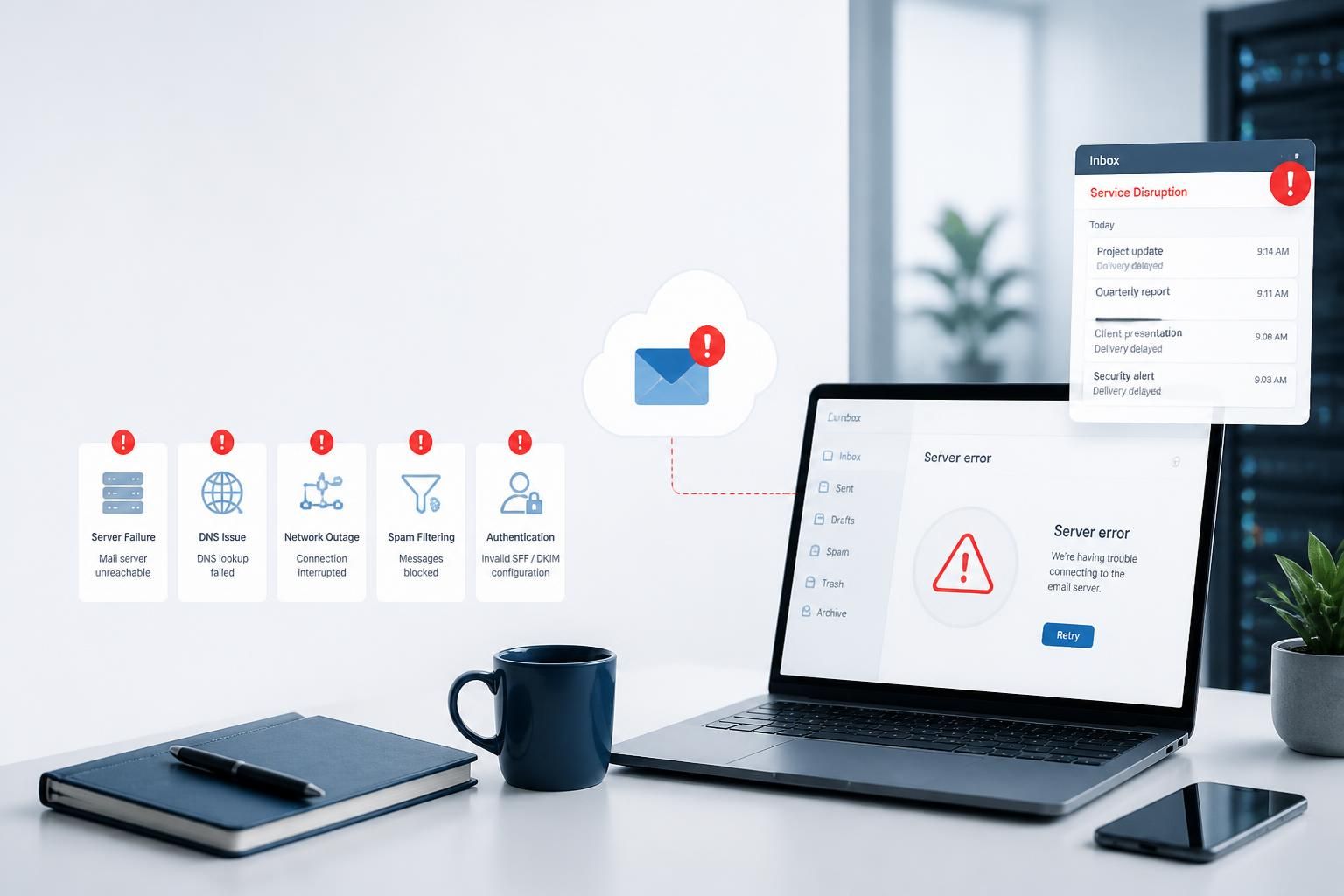
What causes email downtime? Learn the infrastructure, security, and configuration failures behind outages – and how to protect business communications.

Plan a Microsoft 365 migration with clear ownership, secure access, protected data, and a practical rollout that keeps teams productive daily from day one.